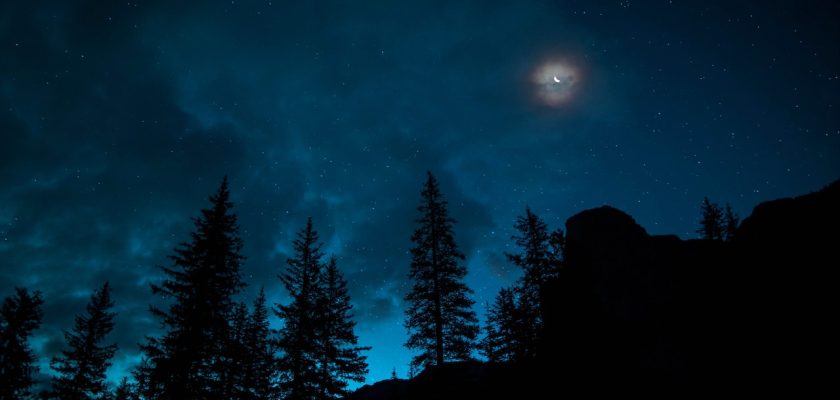
The night sky is a source of endless fascination, beauty, and mystery. From the dazzling stars to the moon’s phases, we can learn a lot about our universe just by looking up at the night sky.
In this blog post, we’ll explore some fascinating facts about night sky viewing. Read on to get inspired and expand your knowledge!
The Moon is Always Changing
The moon goes through eight distinct phases over the course of a single month—which is known as a “lunar cycle” or “moon cycle.” During each phase, the amount of visible light from the moon changes due to its position in relation to Earth and the sun.
When it is located between Earth and the sun, it is known as a “new moon” because none of its light can reach us. As it travels away from Earth and closer to the sun, more of its light reflects off its surface onto Earth, leading to a waxing crescent.
After reaching the first quarter phase (when half of its face is illuminated), it turns into a waxing gibbous before becoming full during its opposition (when it is directly opposite Earth). It then begins waning until it reaches the third quarter phase before turning into a new moon again.
Auroras Are Spectacular Light Shows
An aurora occurs when electrically charged particles are released from both solar winds (from outside our atmosphere) and terrestrial magnetospheric storms (from inside Earth’s atmosphere).
These particles collide with gaseous particles in our atmosphere which causes them to glow different colors depending on their altitude.
Some common colors include green, yellow-green, blue-green, red/pink/purple, white/off-white, and yellow/orange/golden-yellow. Auroras often take on mesmerizing shapes due to their interaction with local magnetic fields in space or near Earth’s surface.
Stars Come in Different Colors
Stars come in multiple colors including blue stars (the hottest), yellow stars (like our sun), orange stars (cooler than yellow stars but hotter than red stars), red stars (the coolest), and white dwarf stars (formed when other types of stars run out of fuel).
Each color has its own characteristic temperature that tells us something about how old they are—blue being young while red being much older.
Additionally, because all objects emit energy as electromagnetic radiation across all wavelengths of the light spectrum there are also brown dwarfs which emit very little visible light at all!
Conclusion
Whether you’re an astronomy enthusiast or just someone who loves marveling at night skies for fun – there are so many interesting things to learn about what exists up above us!
With this blog post you have learned more about the ever-changing phases of our beloved moon; how auroras create spectacular light shows; and that stars come in different colors depending on their age!
So next time you go stargazing make sure you remember these amazing facts about night sky viewing!

