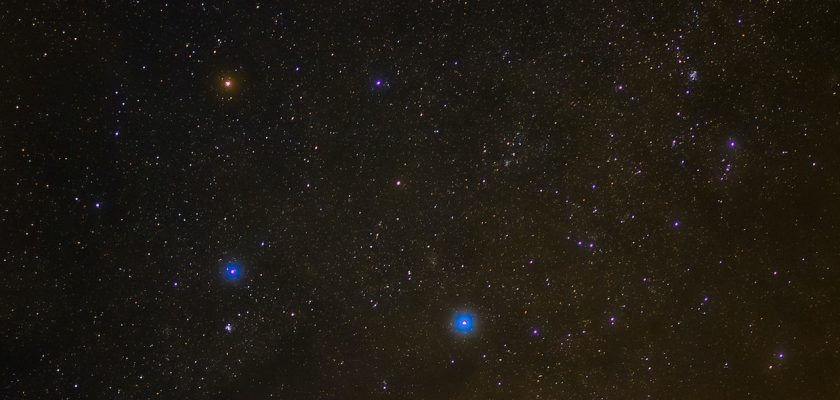
Super Star Clusters (SSC) are collections of thousands of stars that form together in the same region. They are found in galaxies across the universe and are relatively short-lived compared to other stellar formations.
Let’s dive deeper into what makes SSCs so special.
How Super Star Clusters Form
SSCs form when a giant molecular cloud collapses under its own gravity, releasing energy in the form of radiation which ignites new star formation.
This process can result in hundreds or even thousands of stars being born at once, forming an incredibly dense cluster that contains more mass than a typical open cluster.
In addition to their high mass relative to other clusters, SSCs also have very high densities—much higher than regular open clusters.
This is due to their intense gravitational fields which cause stars to coalesce together much closer than normal. The result is a beautiful grouping of many stars that appear as one single entity from Earth’s perspective.
What Makes SSCs So Special?
SSCs are incredibly valuable sources of information for astronomers because they provide insight into how galaxies form and evolve over time.
By studying the properties and characteristics of these clusters, scientists can gain a better understanding of the process by which galaxies develop and grow over time.
Additionally, SSCs help astronomers learn more about star formation in general by providing them with snapshots of how massive star clusters form quickly and efficiently.
Conclusion
Super Star Clusters (SSCs) are unique stellar formations that contain thousands of stars packed closely together and bound by a single gravitational field.
While they may seem like simple cosmic phenomena, they actually provide invaluable insights into how galaxies form and evolve over time.
As such, SSCs are incredibly valuable objects for astrologers who wish to learn more about how stars come together and why certain galaxies look like they do today!

