
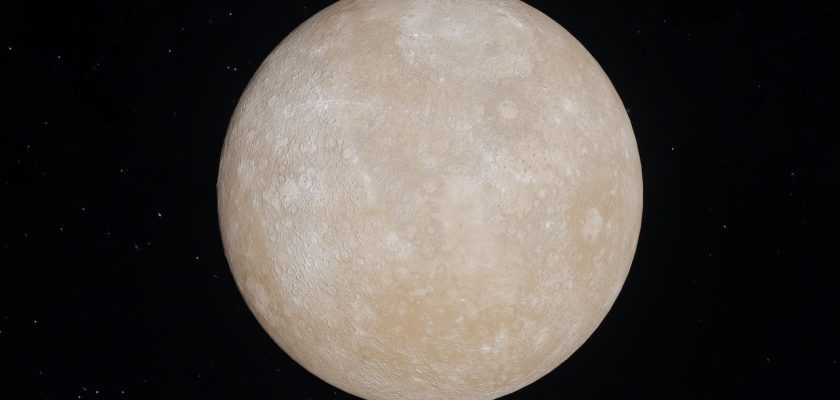
As one of the inner planets closest to our sun, you might think that Mercury would have its own moons. But, in a strange twist of fate, it doesn’t.
So why does Mercury have no moons? Let’s take a look at what we know about this planet and what could be behind its lack of natural satellites.
The Formation Theory
One possible explanation for Mercury’s lack of moons is that it is too close to the sun. This means that any potential moon or satellite that may have been present during Mercury’s formation would have been gravitationally pulled into the planet itself.
This theory is supported by the fact that all four other inner planets—Venus, Earth, Mars, and Jupiter—have multiple moons orbiting them due to their further distance from the sun.
Tidal Forces
Another theory for why Mercury has no moons relates to tidal forces. Tidal forces refer to gravitational pulls between two objects in space—in this case, the sun and a potential moon orbiting around it.
If these two bodies are too close together, the gravitational pull of each on the other can be too strong for a moon to survive; this could explain why there are no moons orbiting Mercury today.
The Age Factor
Finally, some scientists believe that it simply comes down to age; they theorize that while Mercury was once home to several natural satellites billions of years ago, they were eventually lost over time as a result of collisions with asteroids and comets or due to tidal forces with other planets in our solar system.
Conclusion
So while we may never know exactly why there are no known moons orbiting around Mercury today, we do know that it has something to do with its proximity to the Sun and strong gravitational forces within our solar system.
We also know that something similar may have happened billions of years ago when any potential moons were lost over time due to collisions or tidal forces with other planets in our solar system.

