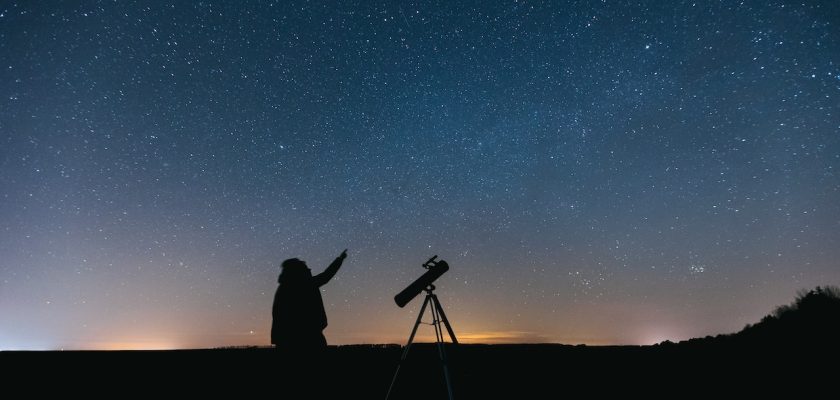
The night sky is full of wonders, from star clusters and galaxies to planets, moons, and nebulae. With a 90mm telescope, you can explore this vast expanse of deep space in incredible detail.
Let’s take a look at some of the amazing objects that can be seen with this versatile piece of equipment.
Planetary Observation
A 90mm telescope is perfect for viewing planets in our solar system. During clear nights, you can get a crisp view of Mars and its ice caps or Saturn and its iconic rings.
You will even be able to see some of Jupiter’s cloud bands, as well as its four largest moons—Io, Europa, Ganymede, and Callisto. In addition to these planets, you may also be able to observe comets passing through our solar system.
Galaxies and Star Clusters
Large-aperture telescopes allow you to observe distant galaxies and star clusters in great detail. With a 90mm telescope, you can get an up-close look at the Andromeda Galaxy (M31), which is located 2.5 million light-years away from Earth!
You can also take in views of the Pleiades star cluster (M45) or the Beehive Cluster (M44). Furthermore, if your telescope has a tracking system installed on it, then you can even take photographs of these interstellar beauties!
Deep Space Objects
In addition to planets and stellar objects, there are many other fascinating deep-space phenomena that you can observe with a 90mm telescope.
These include objects such as planetary nebulae (like M57 in Lyra), supernova remnants (such as SNR 0519–69.0 in the Large Magellanic Cloud), and dark nebulae (like Barnard 33 in Orion). You may even spot some meteor showers taking place during certain times of the year!
Conclusion
A 90mm telescope is an excellent tool for exploring the night sky—and it doesn’t require an expensive setup either!
With this powerful piece of equipment by your side, you’ll be amazed at what secrets lie beyond our planet waiting to be discovered by curious astronomers like yourself.
Whether it’s galaxies far away or meteors close by—you’ll gain a new appreciation for the beauty that exists beyond Earth when using your 90mm telescope!

